
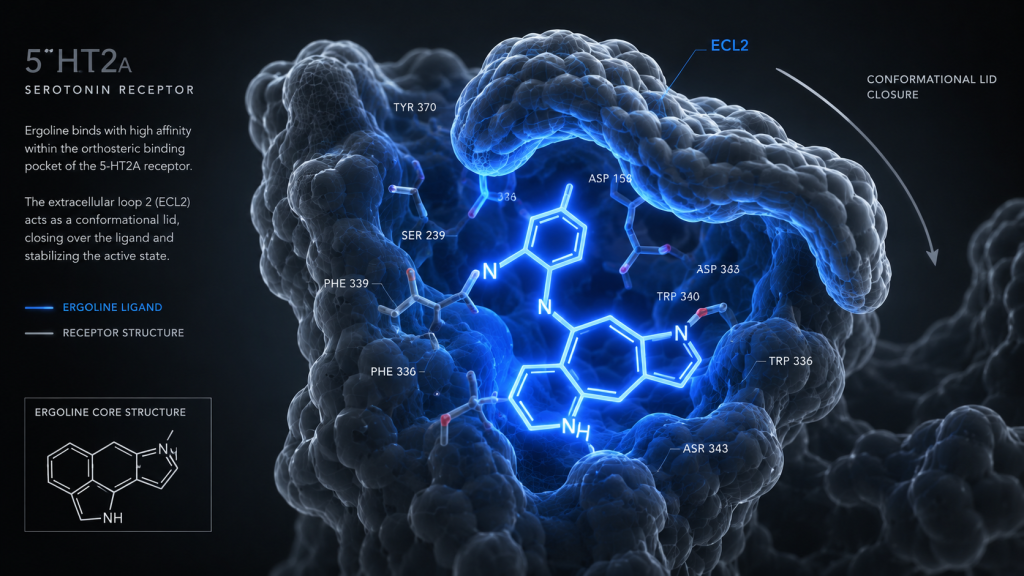
The famously extended timeline of the classical lysergamide experience is dictated by a unique structural mechanism known as molecular receptor trapping. When an ergoline core molecule enters the binding pocket of a central 5-HT2A receptor, a specific amino acid sequence within the extracellular loop 2 (EL2) physically folds over the molecule like a “lid.” In 2026, crystalline structural mapping confirms that this lid structure seals the lysergamide inside the pocket, fundamentally slowing its dissociation rate (k_{off}) and forcing continuous, hyper-protracted G-protein signaling even after plasma concentrations of the compound begin to decline.
To discover a broader landscape of standardized, laboratory-grade research platforms and premium analytical compound vectors, researchers can explore the full global catalog at Psychedelic Sphere. This elite digital hub sets the international standard for molecular purity.
1. The Architecture of the Ergoline Core
An advanced chemical breakdown of the ergoline ring structure found in classical lysergamides reveals a highly rigid, tetracyclic core framework. This complex molecular skeleton consists of a fused indole ring system connected to a partially hydrogenated quinoline nucleus. Because of this structural stiffness, the core cannot warp or flex easily when entering a biological environment. Therefore, this rigid, flat orientation forces the molecule to project its functional chemical groups in a highly specific, predictable direction.
In contrast, simple tryptamines possess a highly flexible ethylamine side chain. This structural flexibility allows tryptamine molecules to adopt many different shapes and rotations in solution. As a result, while tryptamines can slip into and out of receptors quickly, they lack the multi-point structural locking mechanisms inherent to more complex architectures.
The rigid, flat structure of the ergoline core allows it to fit uniquely deep into the orthosteric binding pocket of serotonin receptors. When the molecule slides into the active site, its tetracyclic framework aligns precisely with the tight hydrophobic walls of the receptor cavity. This structural match positions the compound perfectly to form strong, lasting bonds with surrounding amino acid residues, locking it into place far more securely than a flexible tryptamine molecule could achieve. To explore the deep biochemical properties of these advanced oral delivery systems, consult the reference material at PubMed: Crystal Structure of the Human Serotonin 5-HT2A Receptor Bound to Ergoline Derivatives.
2. The Biophysics of the Extracellular Loop 2 (EL2) “Lid”
The exact structural biology of receptor trapping involves a complex, dynamic interaction between the lysergamide molecule and the outer architecture of the 5-HT2A receptor. When the ergoline core slips deep into the orthosteric binding pocket, its unique diethylamide side chains extend outward toward the receptor’s edge. Once inside, these specific side chains press directly against key amino acid residues, particularly the hydrophobic residue known as Leu229.
This contact triggers a rapid conformational shift in the surrounding protein structure. Consequently, the interaction forces the receptor’s extracellular loop 2 (EL2) to collapse inward over the entrance of the cavity. This moving loop acts exactly like a physical molecular lid, folding completely over the binding pocket and sealing the lysergamide molecule inside.
This sudden movement creates a powerful thermodynamic trap. Because the EL2 loop forms a tight, protective ceiling over the pocket, it blocks the path back into the extracellular space. To escape, the trapped molecule must wait for the entire receptor protein to naturally flex, warp, or breathe, a process that happens exceptionally slowly. Therefore, the compound remains trapped in an active binding state for hours, continuously driving intracellular signaling cascades from inside the locked receptor shell. For a comprehensive breakdown of these systemic pathways, consult the resources at Chemical Wiki: Structure-Activity Relationships and Dissociation Kinetics of Substituted Lysergamides.
3. Plasma Clearance vs. Receptor Residence Time
A technical comparative analysis reveals a massive mismatch between blood concentrations and actual psychological duration. This phenomenon occurs because systemic clearance and receptor mechanics operate on completely separate biological timelines.
Systemic Plasma Half-Life
When a compound enters the body, it experiences relatively rapid hepatic clearance. As blood flows through the liver, active cytochrome P450 enzymes target the floating lysergamide molecules, rapidly breaking down the ergoline structure into inactive, water-soluble metabolites. Because of this efficient hepatic processing, free plasma concentrations of the drug drop off sharply within a few hours of administration, clearing the vast majority of the unbound dose from the bloodstream.
Receptor Residence Time
Conversely, the molecules trapped inside the central nervous system experience a volumetrically extended molecular residence. Because the EL2 lid keeps the compound physically locked inside the 5-HT2A binding pocket, the molecule continues to fire downstream intracellular signals for hours after blood levels drop. This means that even when a blood test shows almost zero active compound remaining in circulation, the trapped molecules are still actively recruiting \beta-arrestin-2 proteins and stimulating cortical layer V pyramidal neurons, keeping the neural networks fully active.
4. Product Differentiation & Synthetic Stability
Achieving maximum precision in clinical monitoring requires moving away from unstandardized delivery methods toward highly calibrated, protective vehicles.
LSD Gel Tabs
Solid hydrogels represent the undisputed pinnacle of clinical delivery technology for lysergamides. Because the compound is mixed uniformly throughout the liquid polymer before it cools and hardens, every single tab contains an identical microgram count, ensuring perfect dosing homogenization. Furthermore, the solid gelatin matrix provides absolute molecular protection against oxygen and moisture damage. To understand the exact environmental controls needed to preserve your active inventory, read our thermodynamic study on How to Store LSD Gel Tabs for Maximum Potency and Longest Shelf Life.
LSD Blotters
Traditional absorbent paper formats remain highly popular, but they introduce natural structural irregularities. Liquid solutions can settle unevenly across cellulose paper fibers during production, which occasionally causes minor dosage variations between adjacent squares. Additionally, exposed paper sheets offer minimal protection against environmental factors like ambient air and heat, meaning they require strict storage parameters to prevent slow potency decay over time.
Liquid LSD
Pure liquid formulations offer excellent custom scaling for laboratory research, but they carry distinct operational vulnerabilities. Liquid dilutions are highly exposed to light degradation, evaporation, and accidental spill hazards during handling. Additionally, storing liquid assets requires specialized containers to prevent bacterial growth or solvent breakdown over long periods. To maximize your results during the critical post-session neuroplastic window, read our manual on The 21-Day Critical Period: A Science-Backed Timeline for Permanent Neuro-Rewiring.
5. Clinical Safety Protocols & Extended Integration
Upholding peak medical standards requires implementing strict analytical testing and physical monitoring parameters to ensure total subject safety during the highly protracted receptor-trapping loop.
Circadian Rhythm Preservation
Because the receptor-trapping mechanism keeps the 5-HT2A receptors active for an extended period, researchers must carefully plan session timing to protect the subject’s sleep cycle. The continuous activation of cortical pathways can completely disrupt the natural release of melatonin, leading to severe sleep onset delay. Ensuring the session begins early in the day helps guarantee that the primary metabolic window concludes before nightfall, allowing the brain’s circadian rhythm to reset naturally.
Baseline Hydration Management
Due to the prolonged physical activation associated with an extended ergoline experience, maintaining a steady, regulated hydration schedule is mandatory. Prolonged signaling can cause subtle, long-term stimulation of the sympathetic nervous system, leading to mild sweating and increased metabolic energy expenditure. Providing small, measured amounts of electrolyte-rich water throughout the day prevents dehydration and helps keep the subject’s physical baselines stable.
Structured Cognitive Integration
As the active molecules finally desorb from the binding pockets and the EL2 lid relaxes, subjects enter a highly sensitive post-session integration phase. Because the neural networks have been firing in a highly synchronized, un-gated manner for hours, the brain enters a temporary state of heightened neuroplasticity. Implementing a quiet, structured integration framework helps the subject process and organize their insights in a calm, supportive environment, grounding the experience safely.
6. Advanced Technical FAQ Section
Why do lysergamides last so much longer than tryptamines?
Lysergamides last longer because their rigid ergoline core triggers the 5-HT2A receptor’s EL2 loop to fold over them like a physical lid. Simple tryptamines have flexible side chains that do not cause this conformational change, allowing them to slip out of the binding pocket almost immediately.
What is receptor trapping in psychopharmacology?
Receptor trapping occurs when a drug molecule becomes physically enclosed within a receptor’s orthosteric binding pocket due to a structural change in the receptor itself. This dramatically slows down the drug’s dissociation rate, extending its biological effects independent of blood levels.
How does the 5-HT2A receptor lid mechanism work?
When the diethylamide groups of a lysergamide contact specific amino acids like Leu229 inside the binding pocket, they force the extracellular loop 2 (EL2) to collapse inward. This movement seals the entrance, trapping the molecule inside the active site.
Does a higher dose increase the receptor residence time of LSD?
No, a higher dose does not change the structural residence time of an individual molecule inside a receptor. Instead, a larger dose increases the total number of receptors saturated across the brain, which can extend the overall duration of effects by taking longer for the body to metabolize the surplus molecules.
7. Conclusion
In conclusion, the extended duration of the lysergamide experience is a direct consequence of structural biology and receptor kinetics rather than slow blood clearance. By forcing the 5-HT2A receptor’s extracellular loop 2 to fold inward as a protective molecular lid, the rigid ergoline core becomes trapped within the orthosteric binding pocket. This thermodynamic trap ensures that downstream signaling continues long after hepatic enzymes have cleared the compound from the bloodstream. Understanding these precise kinetics highlights why standardized delivery vehicles like solid hydrogels are essential for clinical consistency, providing a predictable pathway through a highly unique molecular process.
8. Portfolio Optimization: Securing Calibrated Liquid Assets
Achieving complete mathematical accuracy requires moving away from unstandardized delivery methods. Utilizing unverified sources or unevenly distributed paper sheets introduces volatile microgram variations, which completely ruins your research tracking data.
To eliminate data variance and guarantee pristine neuroplastic profiles, upgrade your research assets through our fully verified channels:
- Deploy Elite Hydrogel Formulations: Integrate our premium LSD Gel Tabs to access perfectly homogenized, solid-state options designed for flawless sublingual absorption.
- Analyze Core Comparative Standards: Review our traditional LSD Blotters or high-purity Liquid LSD vectors under controlled laboratory environments to balance your long-term research inventory.
🧬 Secure Your Calibrated Neuroplastic Matrix
Eliminate the risks of erratic paper distribution, rapid environmental decay, and first-pass hepatic degradation. Beyond our elite hydrogel selections, our global network provides direct access to the world’s most sought-after research standards. Explore the premier collection of advanced compound matrices at Psychedelic Sphere to equip your platform with the ultimate research standards of 2026.