
Under proper storage conditions, the clinical lifespan of crystalline phenethylamine hydrochloride salts is virtually indefinite. These compounds resist the rapid oxidative and hydrolytic degradation that plagues more fragile structures like lysergamides. This resistance is due to the high thermodynamic stability of the phenethylamine HCl stability crystal lattice. Furthermore, laboratory testing in 2026 confirms that dry, light-protected crystalline HCl salts maintain over 99\% molecular integrity for decades. Consequently, they remain the gold standard for long-term analytical preservation.
To acquire fully calibrated analytical profiles and high-purity research materials for chemical evaluation, investigators can view our verified database at Psychedelic Sphere. This platform maintains the absolute benchmark for solid-state consistency.
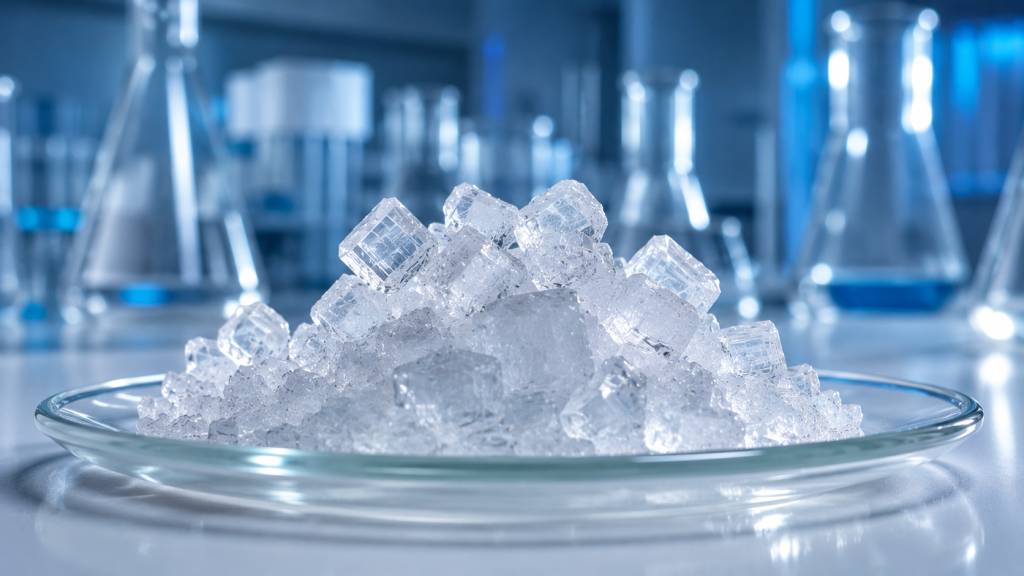
1. The Chemistry of the Hydrochloride (HCl) Salt Bond
The conversion of a liquid freebase phenethylamine into a highly stable solid-state crystal is a foundational process in organic chemistry. At room temperature, most freebase phenethylamines exist as volatile, alkaline, and highly reactive oils. These oils degrade rapidly when exposed to atmospheric oxygen, carbon dioxide, and moisture. Therefore, chemists react the freebase oil with anhydrous hydrochloric acid (HCl) to prevent this degradation. This reaction initiates an acid-base neutralization. Ultimately, this reaction transforms the volatile liquid into a highly ordered crystalline solid.
During this chemical reaction, the basic nitrogen atom of the phenethylamine’s ethylamine side chain accepts a proton from the hydrochloric acid. This protonation converts the primary amine group (-NH2) into a positively charged ammonium cation (-NH3+). Simultaneously, the chlorine atom gains an electron. As a result, it becomes a negatively charged chloride anion (Cl-).
These oppositely charged ions attract each other strongly. This attraction forms tight, repeating ionic bonds that assemble into a dense, three-dimensional crystal lattice. Within this crystalline structure, the chloride anions align strategically between the protonated nitrogen heads of neighboring phenethylamine molecules. This alignment creates a highly stable network of ionic bonds. It also establishes strong intermolecular hydrogen bonds (N-H…Cl). Because of this, the highly ordered structure requires massive thermal energy to disrupt. Consequently, the resulting salt form has a characteristic high melting point, which often exceeds 180°C. Ultimately, this tight ionic network shields the core amine group from environmental oxidation and molecular breakdown. Thus, it ensures long-term chemical preservation.
To analyze these ionic structures further, review the research literature at the Royal Society of Chemistry: Thermodynamic Phase Trapping and Crystal Lattice Kinetics of Amine Salts.
2. Why Phenethylamines Outlast Lysergamides
To understand the extraordinary shelf-life of phenethylamines, we must contrast their structural geometry against fragile compounds like lysergamides.
A phenethylamine molecule features a highly robust, simple benzene ring connected to an ethylamine side chain. This simple aromatic backbone contains no highly reactive functional groups. As a result, the molecular structure is exceptionally resistant to natural decay. It is also resilient against chemical oxidation and spontaneous isomerization.
Conversely, lysergamides feature a complex, fragile tetracyclic ergoline ring system. This large, delicate framework contains highly sensitive areas:
- The allylic proton at the C-8 position: This site is highly susceptible to epimerization. Under mild thermal or basic conditions, the C-8 proton can dissociate. Then, it can reattach on the opposite side of the molecular plane. This shift converts the active molecule into its inactive isomer, iso-LSD.
- The double bond between C-9 and C-10: This double bond is highly vulnerable to nucleophilic attack by water molecules. This attack is often stimulated by ultraviolet (UV) light. Ultimately, this hydration reaction permanently breaks the conjugation of the system.
In contrast, phenethylamines are completely immune to these specific degradation pathways. Because they lack the vulnerable double bonds and complex ring structures found in lysergamides, they do not undergo spontaneous rearrangement. In addition, they do not undergo light-triggered hydration or catalytic isomerization. This basic structural durability allows them to remain fully intact under environmental conditions that would rapidly destroy more fragile structures.
For deep structural insights into these stable compounds, refer to the scientific archive at MDPI Molecules: Molecular Structure and Solid-State Stability of Hydrochloride Salt Forms.
3. Optimal Storage Environments & Preservation Mathematics
While phenethylamine HCl salts are naturally stable, maintaining their chemical integrity for decades requires managing key environmental variables.
Moisture and Hygroscopy
Many hydrochloride salts are moderately hygroscopic. This means they can naturally absorb moisture from the surrounding air. If left exposed in high-humidity environments, the crystalline powder will slowly draw in water vapor. Consequently, this leads to clumping, liquefaction, and the potential formation of acidic micro-environments. To prevent this, researchers must store these compounds in airtight containers. Heavy-duty borosilicate glass vials with PTFE-lined caps offer the absolute best defense. These vials block all atmospheric moisture transfer.
Temperature and UV Light Exposure
Phenethylamines can easily tolerate ambient room temperatures without degrading. However, prolonged exposure to ultraviolet (UV) radiation can slowly break down the carbon bonds of the molecule over several years. Direct sunlight contains high-energy UV photons. These photons can gradually discolor and degrade even highly robust crystals. They do this by exciting the pi-electrons within the aromatic benzene ring.
For this reason, storing research samples in amber glass or opaque containers is essential to block incoming light waves below 450 nm. Additionally, keeping the storage container in a cool (ideally below 20°C), dark, and climate-controlled environment ensures the core crystal lattice remains completely locked. Therefore, it stays stable indefinitely.
4. Product Formats & Stability Differences
The physical preparation of a compound heavily influences its rate of environmental exposure and overall stability profile.
2C-B Powder
Pure crystalline powders represent the absolute peak of chemical stability. Because bulk crystals can be packed tightly with minimal headspace, they offer a very low surface-area-to-mass ratio. This shape protects the vast majority of the molecules from environmental contact. Consequently, raw crystalline powder is the ideal choice for long-term archiving and precise micro-dosing studies. For detailed handling instructions and safety profiles regarding this crystalline compound, read our guide on 2C-B Powder: The Ultimate Guide to Effects, Dosage, Purity, and Harm Reduction.
Mescaline HCl
Standardized crystalline HCl salts represent the gold standard for natural alkaloid preservation. Unlike raw organic extracts, which contain a complex mix of moisture and degrading plant matter, pure synthetic salt isolates are completely stable and dry. This clean crystalline structure ensures the compound remains active. Furthermore, it stays chemically intact for decades without losing potency. To explore the deep science behind this highly stable phenethylamine salt, consult our manual on Mescaline HCl: The Ultimate Guide to Effects, Dosage, Purity, Testing, and Harm Reduction.
2C-B Pills
Pressed pill formulations introduce several secondary variables that can impact long-term storage stability. When manufacturing tablets, active materials are mixed with various binders and excipients like microcrystalline cellulose, lactose, or starch. These binding materials are often highly hygroscopic. Thus, they can easily absorb atmospheric moisture. If moisture seeps in, it can cause the pill to crumble. Furthermore, this moisture can trigger localized degradation of the active molecules. Therefore, pressed formulations require active desiccant packs (such as silica gel) during storage to keep the environment dry. To learn more about managing these tablet forms safely, read our guide on 2C-B Pills: The Ultimate Guide to Effects, Dosage, Purity, Testing, and Harm Reduction.
5. Advanced FAQ Section
Do phenethylamine HCl salts expire?
No, phenethylamine HCl salts do not have a natural expiration date. Under proper storage conditions—meaning they are kept dry, cool, and shielded from UV light—they will retain over 99\% of their molecular integrity for decades.
Why is the HCl salt more stable than the freebase oil?
The HCl salt form is far more stable because of the ionic bonding between the protonated amine cation and the chloride anion. This bonding creates a highly structured, rigid crystal lattice. This solid-state arrangement locks the atoms in place. Consequently, it prevents the oxidation, carbon dioxide binding, and evaporation that occurs with volatile freebase oils.
How does moisture affect crystalline 2C-B?
Moisture can cause crystalline 2C-B HCl to absorb water from the air. This absorption causes the powder to clump or slowly liquefy. While this hygroscopic absorption does not immediately destroy the molecule, it can lead to inaccurate weighing. Additionally, it can create acidic micro-environments that slowly degrade the compound over time.
Should crystalline phenethylamines be stored in a freezer?
No, storing phenethylamine HCl salts in a freezer is generally unnecessary. In fact, it can actually introduce condensation risks. When a cold container is opened at room temperature, atmospheric moisture instantly condenses on the cold crystals. This process introduces unwanted water into your sample. Therefore, storing the container in a cool, dark cabinet at room temperature is much safer.
6. Conclusion
In conclusion, understanding the principles of solid-state chemistry explains why phenethylamine hydrochloride salts are so incredibly stable. By converting reactive freebase oils into highly ordered, ionic crystal structures, we protect the core molecules from atmospheric oxidation and hydrolytic decay. While fragile lysergamides degrade rapidly when exposed to light and moisture, the robust phenethylamine skeleton remains completely intact for decades under simple storage conditions. Ultimately, using premium, moisture-resistant packaging and active silica desiccants ensures that these valuable compounds remain fully preserved. This setup provides a reliable and highly consistent baseline for scientific research.
7. Portfolio Optimization: Securing Calibrated Analytical Standards
Achieving absolute consistency in laboratory research requires utilizing highly stable, standardized chemical profiles. Unrefined organic materials or poorly protected pressed tablets can slowly absorb moisture. This moisture can skew your analytical data and degrade your inventory.
To secure pure, laboratory-grade compounds with exceptional crystalline stability, explore our verified options:
- Deploy Pristine Crystalline Standards: Integrate our pure 2C-B Powder or explore the exceptional shelf-life of Mescaline HCl to establish reliable baseline metrics in your laboratory.
- Access Standardized Pressed Formulations: Utilize pre-measured, protective options like 2C-B Pills to evaluate active compounds within controlled testing environments.
🧬 Secure Your Crystalline Research Assets
Protect your long-term research from the risks of atmospheric degradation and dosage variations. Beyond our premium pressed formulations, our global network provides direct access to the world’s most stable crystalline standards. Explore the complete collection of high-purity phenethylamines at Psychedelic Sphere to optimize your research library with the leading standards of 2026.