
The Thalamic Gating Theory posits that the thalamus functions as the brain’s central sensory filter or “gatekeeper,” preventing the cerebral cortex from being overwhelmed by the massive influx of external environmental stimuli. When classical tryptamines introduce potent agonists to the highly concentrated population of 5-HT2A receptors within the thalamic reticular nucleus (TRN) and cortical layer V, they disrupt this stabilized inhibitory feedback loop. This breakdown of the thalamic gate remains the leading neurobiological explanation for the vivid synesthesia, altered sensory perception, and profound ego dissolution that characterize the classical psychedelic experience.
To explore an extensive selection of standardized research profiles and high-purity molecular vectors designed for advanced clinical observation, investigators can access our central catalog at Psychedelic Sphere. This platform serves as a benchmark for analytical consistency and precision.
1. The Neuroanatomy of the Thalamic Filter
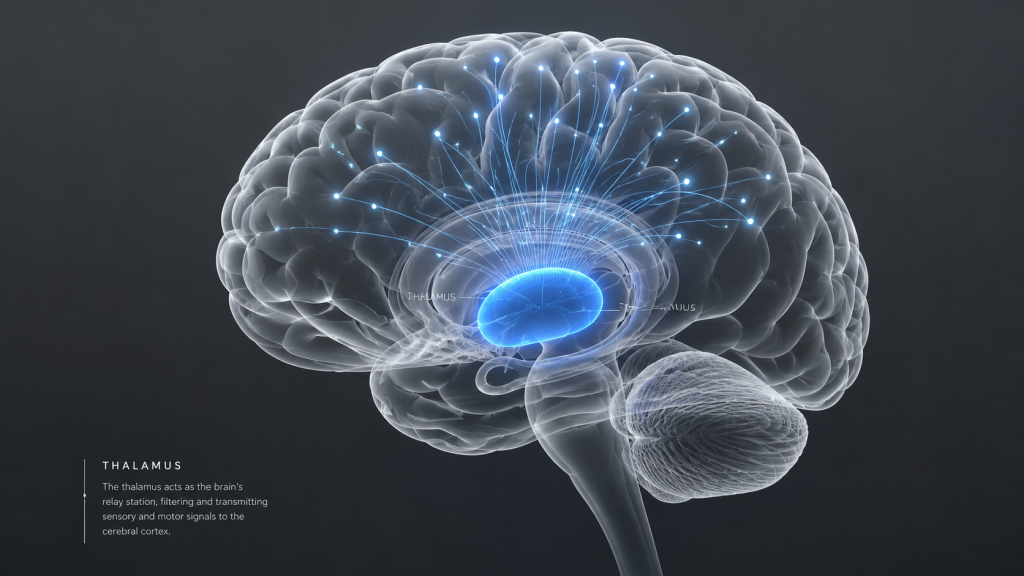
The architectural foundation of human conscious awareness depends heavily on the structural organization of the Cortico-Striato-Thalamo-Cortical (CSTC) loop. Consequently, this neural network regulates the amount of sensory input that reaches the cerebral cortex for conscious processing. Within this complex system, the thalamus operates as a central gateway. It receives raw afferent signals from the visual, auditory, and somatosensory organs. After that, it routes them to their respective primary cortices. For a complete overview of these structural sorting mechanisms, read the technical documentation at Neuroanatomy Wiki: Structural Organization and Filtering Pathways of the Thalamus.
Surrounding the lateral dorsal aspects of the thalamus is a specialized anatomical structure known as the Thalamic Reticular Nucleus (TRN). The TRN functions as an inhibitory shell or a physical gatekeeper. Furthermore, it is composed entirely of GABAergic interneurons. The TRN actively monitors both incoming signals from the periphery and descending feedback from the cortex. When irrelevant, redundant, or background stimuli attempt to flood conscious awareness, the TRN fires rapidly. Therefore, it releases gamma-aminobutyric acid (GABA) to suppress those specific thalamocortical channels.
This active downregulation successfully prevents sensory overload. As a result, the brain can maintain focus on high-priority environmental variables while ignoring background noise. In a healthy baseline state, the CSTC loop functions as a balanced feedback system. The cortex sends excitatory signals to the striatum. Following this, the striatum modulates inhibitory outputs to the thalamus. This process ensures that the TRN can effectively fine-tune the sensory gate and protect the primary sensory cortices from being overwhelmed.
2. The Molecular Mechanics of Gating Disruption
The introduction of classical tryptamine molecules destabilizes the delicate balance of the CSTC loop. This disruption happens via high-affinity agonism at the 5-HT2A receptor site. These specific serotonin receptors are heavily expressed on the dendrites of glutamatergic pyramidal neurons within layer V of the prefrontal cortex. In addition, they are found on the inhibitory interneurons of the TRN itself. When a tryptamine molecule binds to these sites, it triggers a powerful intracellular cascade. Consequently, this cascade completely alters baseline signaling.
Instead of maintaining a steady, regulated flow of information, the activated cortical layer V pyramidal neurons experience intense, asynchronous firing. This phenomenon causes a massive increase in glutamate release across descending pathways. Because of this, the incoming signals over-stimulate the thalamus and overwhelm the TRN’s regulatory capacity. As the TRN is bombarded with excess glutamate, its selective GABAergic inhibition breaks down completely.
This shift marks the transition from a closed, selective sensory filter to an open, un-gated state of hyper-connectivity. For this reason, the TRN loses its ability to filter or downregulate incoming signals. Raw, unrefined sensory information passes through the gateway completely unchecked. Ultimately, this flaw floods the cerebrum with an intense stream of unfiltered data. To examine how these changes alter overall cognitive and sensory metrics, consult the literature at PubMed: The Cortico-Striato-Thalamo-Cortical Loop and Sensory Gating Metrics.
3. Sensory Overload, Synesthesia, and Cortical Integration
When the thalamic gate fails completely, the primary sensory cortices are bombarded with an un-attenuated influx of data. As a result, this collapse leads to a profound restructuring of conscious experience. Under normal conditions, the visual, auditory, and somatosensory cortices operate within strictly segregated channels. This means that the thalamocortical pathways keep these signals isolated from one another.
However, when the filter collapses, these boundaries dissolve. Raw electrical signals from the optic nerve, the cochlea, and peripheral nerves arrive at the cortex simultaneously. Furthermore, they crash into the brain with maximum intensity. This sudden influx forces different cortical regions to integrate signals that are typically processed separately. Therefore, the resulting cross-talk across normally isolated brain networks provides a direct explanation for the phenomenon of synesthesia. For example, subjects perceive sounds as vibrant colors or visual patterns as distinct auditory tones.
At the same time, this un-gated sensory flood overwhelms the Default Mode Network (DMN). This higher-order brain system is responsible for maintaining a cohesive sense of time, memory, and personal identity. However, as the DMN is flooded with raw, un-filtered sensory data, its internal synchronization breaks down entirely. This breakdown results in the profound state of ego dissolution often documented during intense tryptamine research. Consequently, the psychological boundary between the observer and the external environment disappears into a single, unified sensory field.
4. Product & Research Formulation Optimization
Investigating these profound shifts in sensory gating requires utilizing highly calibrated, pure molecular profiles. This step is necessary to ensure consistent and reproducible research data.
Magic Mushrooms
Unrefined natural profiles provide an organic mix of tryptamine alkaloids. However, their physical composition introduces natural baseline variations. The active microgram content within raw fungal material can fluctuate drastically based on specific cultivation parameters. Additionally, substrate composition and long-term storage conditions affect potency. These natural shifts make it difficult to establish precise pharmacokinetic baselines during clinical gating studies. To learn how to safely manage and mitigate the intensive sensory effects of these natural variations, consult our protocol on The Science of Bad Psychedelic Trips: Causes, Prevention, and 2026 Safety Protocols.
Psilocybin Mushroom Capsules
Encapsulated formulations offer a major upgrade in dosing accuracy by utilizing pre-measured, standardized compound matrices. By sealing a uniform distribution of active molecules inside a protective capsule, researchers eliminate the dosing guesswork associated with unrefined raw material. Therefore, this delivery method ensures a predictable metabolic pathway. This allows investigators to track onset timelines and receptor saturation windows with high accuracy. To prepare your laboratory environment for these standardized profiles, read our strategic blueprint on The Pre-Journey Protocol: The Complete Guide to Safe, Intentional Psychedelic Preparation.
5. Clinical Safety Protocols & Sensory Harm Reduction
Upholding peak scientific standards requires implementing strict environmental controls. These choices protect subjects while the thalamic filter is in an un-gated state.
Low-Stimulus Environment Design
Because an open thalamic filter allows all incoming sensory data to reach conscious awareness without attenuation, the subject becomes highly vulnerable to external stressors. For instance, loud, unexpected noises or chaotic, flashing lights can easily cause severe sensory overload. This reaction triggers intense physiological stress responses. For this reason, clinical settings must prioritize a low-stimulus environment. They should utilize soft, indirect lighting and sound-dampening architecture to keep the influx of sensory data within comfortable boundaries.
Auditory and Visual Calibration
To prevent unexpected cross-activation and manage synesthetic feedback loops, any auditory or visual stimuli used during a session must be carefully calibrated. For example, implementing neutral, ambient soundscapes without sudden shifts in tempo or volume helps stabilize the open auditory pathways. Additionally, providing a simple, comfortable eye covering minimizes erratic visual input. This tool allows the subject’s primary visual cortex to process the internal experience smoothly without external interference.
Metabolic Tracking and Integration
Due to the profound shifts in perception that occur when the sensory gate is wide open, researchers must carefully track the peak metabolic window of the chosen compound. Monitoring the subject’s vital signs, such as heart rate and blood pressure, ensures they remain physically stable during the period of maximum receptor saturation. Once the compound begins to clear, the TRN restores its baseline inhibitory control. After that, a structured integration phase helps the subject process the unfiltered experience safely and comfortably.
6. Advanced Technical FAQ Section
What is the Thalamic Gating Theory?
The Thalamic Gating Theory is a neurobiological model. It states that the thalamus acts as a central filter for the brain, screening out irrelevant sensory information to prevent the cerebral cortex from being overwhelmed by environmental input.
How does the brain filter sensory information normally?
In a healthy baseline state, the Thalamic Reticular Nucleus (TRN) uses GABAergic interneurons to downregulate background noise, visual distractions, and redundant sensory inputs before those signals can reach conscious awareness.
Which receptors are responsible for opening the thalamic gate?
The primary sites responsible are the 5-HT2A receptors. These are located on cortical layer V pyramidal neurons and within the TRN. Agonism at these sites disrupts the inhibitory feedback loop, causing the gate to open.
Can sensory gating deficits cause permanent changes to perception?
No, classical tryptamines cause a temporary, reversible alteration in sensory gating. This state resolves completely as the active molecules desorb from the 5-HT2A receptors and undergo normal metabolic clearance.
7. Conclusion
In summary, the Thalamic Gating Theory provides a clear, valuable framework for understanding the neurobiology of altered sensory states. By disrupting the inhibitory controls of the Thalamic Reticular Nucleus via 5-HT2A receptor activation, classical tryptamines temporarily lower the brain’s natural sensory filters. This flaw allows an unfiltered stream of sensory data to flood the primary cortices simultaneously. Consequently, this flood dissolves normal sensory boundaries and leads to phenomena like synesthesia and ego dissolution. Utilizing standardized, high-purity research formulations allows scientists to safely explore these mechanisms, giving us a deeper understanding of human consciousness and sensory processing.
8. Portfolio Optimization: Securing Standardized Research Assets
To maintain total data accuracy during advanced sensory gating studies, researchers must avoid uncalibrated, variable sources. Inconsistent active concentrations can disrupt your research tracking and alter your metabolic baselines.
To secure complete chemical consistency and pristine molecular profiles, upgrade your research assets through our fully verified channels:
- Deploy Standardized Matrix Profiles: Inject our precise Psilocybin Mushroom Capsules into your protocol to ensure identical dosage metrics and smooth, predictable delivery timelines.
- Analyze Advanced Organic Baselines: Integrate organic baselines using Magic Mushrooms within controlled laboratory environments to track historical gating traits.
🧬 Access Your Calibrated Molecular Standards
Eliminate the variable results caused by uneven alkaloid distribution and poor storage protection. Beyond our specialized capsule profiles, our global distribution network provides direct access to the world’s most precisely manufactured research standards. Explore the complete collection of advanced compound matrices at Psychedelic Sphere to equip your platform with the ultimate clinical tools of 2026.