
The thermodynamic lifespan of an LSD blotter depends heavily on its delicate ergoline ring structure. This core framework is highly vulnerable to thermal, catalytic, and photo-oxidative degradation. Unlike solid hydrogels, a porous cellulose paper matrix exposes embedded lysergamides to microscopic ambient airflow and moisture. Consequently, this exposure accelerates the epimerization of the active compound into inactive iso-LSD. Furthermore, it triggers photo-oxidation into lumi-LSD. In 2026, analyzing these precise chemical thermodynamic vectors remains the definitive framework for understanding molecular preservation. Therefore, it is the best method to prevent long-term structural decay in paper mediums.
1. The Vulnerabilities of the Ergoline Ring System
A deep structural chemistry analysis reveals the fundamental weaknesses engineered into the tetracyclic core of the lysergamide molecule. The ergoline ring system is not a chemically static framework. Instead, it contains highly specific reactive centers. Because of these weak spots, environmental forces cause rapid structural breakdown.
The primary site of structural instability sits localized at the C-8 position, which is right adjacent to the carboxamide group. When thermal energy or atmospheric moisture is present, the C-8 position undergoes spontaneous epimerization. This reversible chemical reaction alters the spatial orientation of the diethylcarboxamide functional group. As a direct result, the process converts the pharmacologically active d-LSD molecule into its stereochemically inactive diastereomer, d-iso-LSD. This structural shift completely eliminates the molecule’s binding affinity for central serotonin receptors, although it does not alter its elemental composition.
Simultaneously, the conjugated indole ring system of the ergoline core exhibits extreme sensitivity to ultraviolet (UV) radiation. High-energy photons easily disrupt the electron configuration across the aromatic system. Specifically, they target the critical 9,10-double bond. This photo-activation quickly catalyzes a nucleophilic water addition across the double bond. Consequently, the reaction converts the molecule into a completely inactive photoproduct known as lumi-LSD. For a comprehensive overview of these molecular configurations, review the data at Organic Chemistry Wiki: Structural Geometry and Chemical Properties of the Ergoline Core.
2. The Material Science of the Cellulose Matrix (Paper Physics)
Analyzing paper as a chemical delivery system requires a thorough investigation into the microscopic structure of absorbent cotton blotter sheets. Raw blotter sheets consist of interwoven cellulose polymer fibers. These fibers form a highly porous, capillary-driven mesh network. While this open cellular architecture is ideal for absorbing liquid solutions evenly, it presents a hostile environment for long-term molecular stability.
Moreover, the porous network of an unrefined cellulose sheet creates a massive total surface area relative to its localized volume. When a researcher deposits a lysergamide solution onto the paper, the molecules spread thinly along the outer surfaces of the exposed cellulose fibers. Therefore, the active compound rests in an open-air configuration. This state directly exposes individual molecules to any ambient atmosphere trapped within the paper’s pores.
This continuous open-air exposure contrasts sharply with the protective, airtight properties of an integrated gelatin or polymer hydrogel grid. In a solid matrix, manufacturers physically lock the active compound inside an impermeable molecular cage. This cage completely blocks gas exchange and localized moisture movement. On the other hand, the molecule remains constantly vulnerable on open cellulose fibers. It faces regular exposure to the microscopic airflow, volatile contaminants, and atmospheric changes that pass straight through the unsealed sheet.
3. Thermodynamic Catalysts of Decay
The kinetic rate of lysergamide degradation on open cellulose fibers depends on three core environmental variables. These variables act as direct thermodynamic catalysts for decay.
- Thermal Energy (Kinetic Acceleration): First, elevated ambient temperatures supply the required activation energy (E_a) to speed up molecular rearrangement. As thermal energy increases, the molecular vibrations within the ergoline ring intensify. Consequently, this change drastically boosts the velocity of the C-8 epimerization reaction that yields inactive d-iso-LSD.
- Photo-Oxidation (Photon Bombardment): Second, specific ultraviolet wavelengths act as direct energy packets. These packets break down molecular bonds instantly upon contact. The indole ring absorbs this photon energy, which triggers an immediate radical reaction. Thus, the process cleaves the 9,10-double bond and forces the structural conversion into lumi-LSD.
- Atmospheric Oxygen & Ambient Moisture (H_2O): Finally, relative humidity acts as a dynamic solvent on open cellulose fibers. Trapped water vapor molecules facilitate the proton transfer required for C-8 epimerization. Meanwhile, atmospheric oxygen drives free-radical oxidative pathways that break down the core aromatic structure of the phenethylamine chain.
To explore peer-reviewed research papers tracking these specific lysergamide transport and decay variables, consult the index at PubMed: Research Papers on the Identification and Stability of Lysergamides.
4. Product Spectrum Contextualization
Optimizing chemical preservation protocols requires comparing the classic paper matrix against alternative physical delivery vectors. This comparison helps balance structural stability with utility.
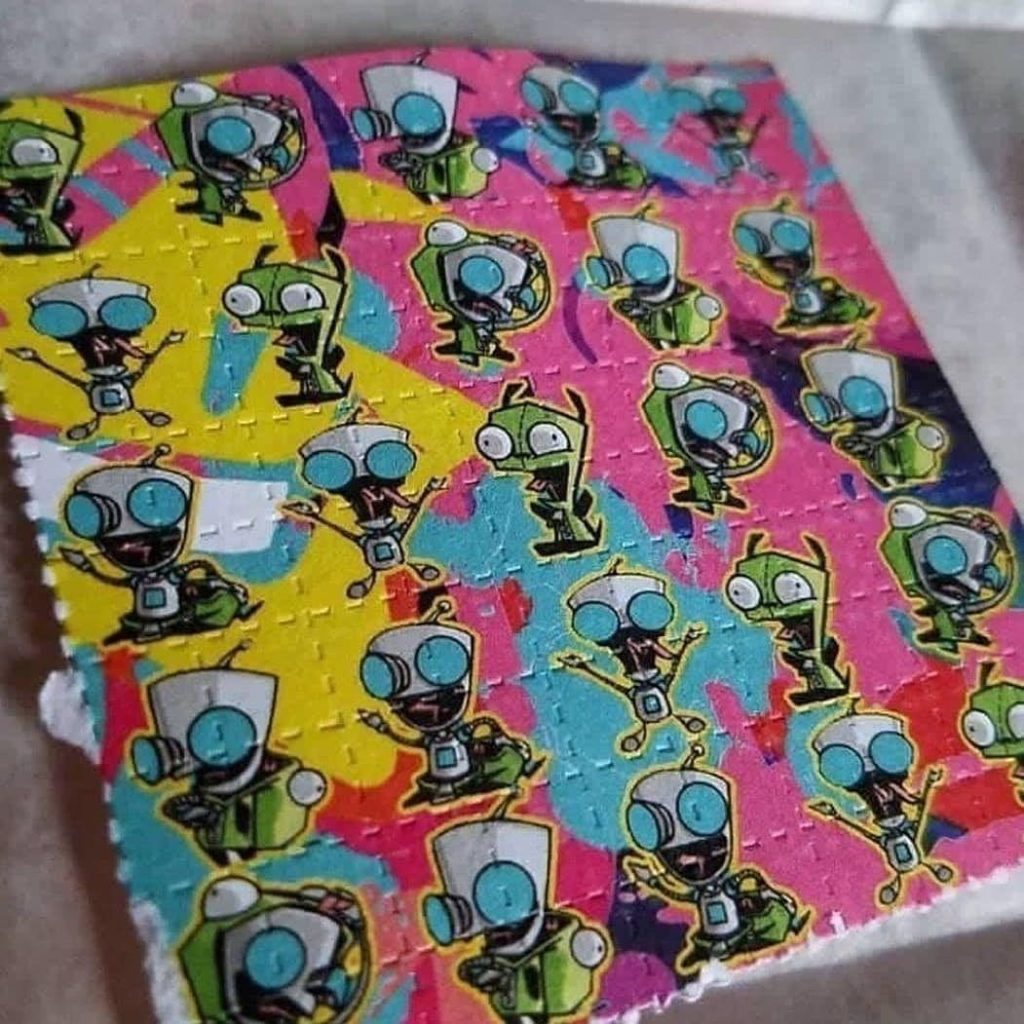
LSD Blotters
The classic paper format serves as an iconic, historically significant medium. However, it demands strict physical protection due to its open cellular architecture. Because the porous cellulose web leaves the delicate ergoline rings fully exposed to atmospheric catalysts, paper sheets require strict environmental isolation to prevent rapid potency drops. To master the operational parameters and history of this traditional format, read our manual on LSD Blotters: The Ultimate Guide to Effects, Dosage, History, and Harm Reduction.
LSD Gel Tabs
In comparison, solid brass hydrogel matrices represent a superior evolutionary advancement in preservation technology. By locking the active compound inside a dense, solid-state lipid or gelatin polymer grid, this format acts as an airtight seal. Therefore, it shields active ingredients from atmospheric breakdown and ambient gas exchange. To analyze how these physical delivery mediums compare during research, read our comparative overview on LSD Blotters vs Gel Tabs: Which Form Is Easier to Use, More Classic, and Better for Beginners?.
Liquid Solutions
Liquid alternatives, such as ethanol or distilled water mixtures, offer highly uniform distribution for exact measurement across analytical sessions. However, this format is entirely reliant on the thermodynamic stability, purity, and temperature of the container solvent. If the liquid carrier contains chlorine ions or experiences exposure to light, the dissolved molecules degrade rapidly. For this reason, storage climate parameters remain highly critical. To implement precise preservation steps for your materials, consult our technical protocol on How to Store LSD Blotters Properly: Tips for Maximum Potency & Long-Term Shelf Life.
5. Theoretical Mitigation Protocols (Scientific Harm Reduction)
Slowing down the thermodynamic decay of lysergamides within a cellulose matrix requires strict preservation protocols. These steps derive directly from physical chemistry principles.
Absolute Photon Exclusion
To completely stop photo-oxidative pathways, researchers must keep the porous cellulose matrix in total darkness. Utilizing opaque barriers, amber borosilicate vials, or thick aluminum foils blocks incoming light waves completely. Consequently, this exclusion prevents photons from striking the indole ring, permanently stopping the conversion into lumi-LSD.
Desiccation and Moisture Control
Because water vapor acts as a catalytic solvent for C-8 epimerization, researchers must reduce relative humidity levels. Sealed containers must utilize active desiccant packs, such as synthetic silica gel. These packs drop ambient moisture levels below 10%. As a result, this dry microclimate dehydrates the open cellulose fibers and locks the compound into a stable, non-reactive state.
Thermal Stabilization
Slowing down molecular movement requires dropping the ambient temperature significantly. Storing sealed, desiccated matrices in sub-zero environments decreases the available thermal kinetic energy. Therefore, it drops the energy below the activation threshold required for epimerization. This sharp reduction in molecular velocity successfully extends the thermodynamic shelf life of the material from months to decades.
6. Advanced Technical FAQ Section
What is the difference between iso-LSD and lumi-LSD?
Iso-LSD is a diastereomer formed when thermal energy or moisture causes the C-8 position of the molecule to epimerize, changing its spatial structure. On the other hand, lumi-LSD is a completely distinct photoproduct. It forms when ultraviolet light forces a water molecule to add across the 9,10-double bond of the indole ring. Both products are completely inactive.
Does paper type affect the degradation rate of lysergamides?
Yes, absolutely. Highly bleached, unrefined, or acidic wood-pulp papers contain residual chemicals, lignin fragments, and chlorine ions from manufacturing. These residual contaminants act as local catalysts that accelerate the chemical breakdown of the ergoline core. For this reason, pure, acid-free cotton cellulose blotter sheets remain mandatory.
Why does UV light break down an indole ring so rapidly?
The indole ring within the ergoline core contains a highly conjugated pi-electron system that readily absorbs ultraviolet photons. This sudden influx of electronic energy destabilizes the 9,10-double bond. Consequently, it creates a high-energy intermediate that reacts instantly with surrounding moisture to form lumi-LSD.
How does moisture accelerate chemical epimerization on open fibers?
Water vapor acts as a localized proton donor and acceptor on the surface of the cellulose fibers. This catalytic solvent environment reduces the activation energy needed for the hydrogen atom at the C-8 position to detach. When it reattaches in an inverted spatial position, it rapidly lowers the active compound purity.
7. Conclusion
In summary, the material physics of the cellulose blotter sheet dictates that the longevity of embedded lysergamides depends entirely on strict climate control. Because the porous network of paper fibers leaves the delicate ergoline ring structure completely open to atmospheric degradation, thermal energy, and photon bombardment, unsealed sheets inevitably face rapid epimerization and photo-oxidation. However, by applying targeted preservation protocols—specifically absolute photon exclusion, deep desiccation, and thermal stabilization—researchers can effectively halt these thermodynamic pathways. This control successfully secures the structural integrity and long-term baseline of the compound.
8. Portfolio Optimization: Securing Calibrated Storage Assets
Achieving total mathematical consistency in your research requires moving away from poorly preserved, open-air paper materials. Degraded sheets introduce massive potency variations and high percentages of inactive iso-LSD. Consequently, this decay heavily compromises your analytical data.
To eliminate baseline instability and ensure pristine molecular preservation, transition your storage protocols to our fully standardized options:
- Deploy High-Stability Paper Matrices: First, utilize our professionally managed LSD Blotters under strict climate control parameters. This approach maintains absolute historical and analytical baseline consistency.
- Integrate Advanced Sealed Hydrogels: Second, adopt our evolutionary LSD Gel Tabs to leverage an impermeable polymer grid. This structure inherently seals the active compound away from atmospheric oxygen and moisture.
🧬 Secure Your Calibrated Thermodynamic Matrix
Eliminate the risks of rapid thermal epimerization, destructive photo-oxidation, and erratic open-fiber degradation. Click the optimized product options above to equip your platform with the premier structural preservation standards of 2026.