
Tobacco addiction remains the most difficult behavioral loop to break in modern medicine. While patches and gums attempt to manage withdrawal, they rarely address the underlying neural architecture of the “smoker identity.” However, as of March 2026, clinical data has crowned a new leader in addiction medicine.
The latest randomized clinical trial from Johns Hopkins University confirms that psilocybin is the most powerful tool ever discovered for long-term abstinence. This landmark study, published in JAMA Network Open, shows that a single high-intensity session is six times more effective than the standard nicotine patch. This isn’t just a lifestyle change. It is a biological reset.
The 6x Breakthrough: Why Psilocybin Outperforms the Patch
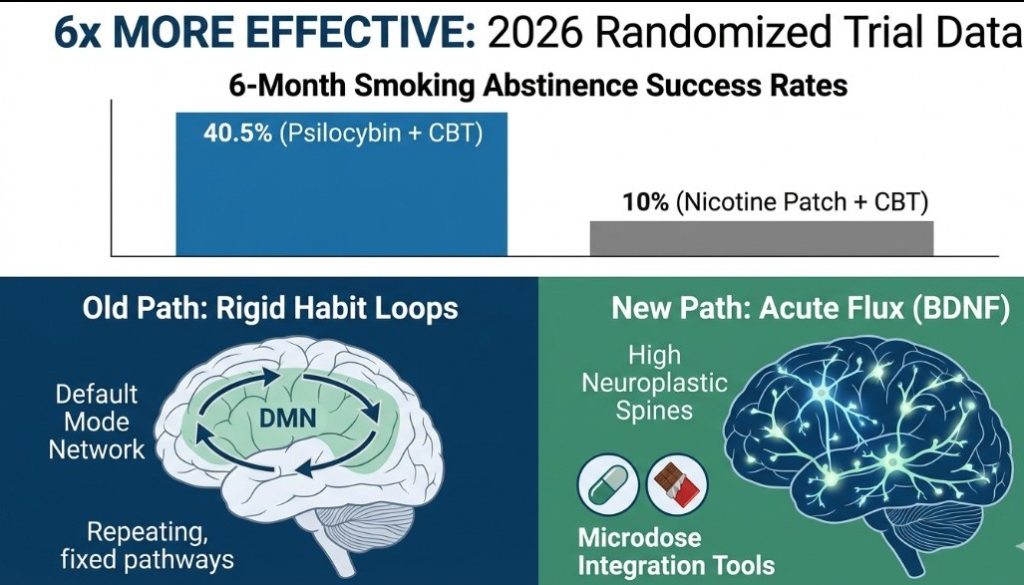
The scientific community is currently reeling from these results. In this trial, participants using psilocybin alongside cognitive therapy achieved a 40.5% abstinence rate at the six-month mark. For comparison, the group using traditional nicotine patches achieved only 10%.
The difference lies in Perspective Shift. Nicotine patches feed the addiction to prevent pain. Psilocybin, however, creates a “Mental Reset.” It allows the user to view their addiction from an objective, third-person perspective. This shift turns a “craving” into an “obsolete data point” that no longer requires action.
The Biology of the “Break”: DMN Deactivation
Addiction thrives in a brain network called the Default Mode Network (DMN). This network manages your habits and your internal narrative. For a smoker, the DMN is hard-wired to associate specific triggers—like stress or a morning coffee—with the act of lighting a cigarette.
Psilocybin molecules target the 5-HT2A serotonin receptors to temporarily “shatter” the DMN’s influence. This creates a state of Maximum Neural Flux. In this state, the brain releases a flood of BDNF (Brain-Derived Neurotrophic Factor). BDNF acts as neural fertilizer. It allows your brain to grow new dendritic spines and form healthy, non-addictive pathways.
The 21-Day Cessation Timeline
Quitting smoking is not an event; it is a 504-hour biological process. To ensure the nicotine “loop” never returns, you must follow the three stages of neuro-rewiring.
Phase 1: The 72-Hour Flux
The first three days after your session are the most critical. Your brain is essentially “wet cement.” During this window, you must avoid all old smoking triggers. Your “Internal Loop” is at its weakest point, which we also explore in our OCD ‘Mental Loop’ Breakthrough. This is the time to stabilize your new identity.
Phase 2: Structural Synaptogenesis (Days 4–14)
By the end of the first week, your brain begins building physical infrastructure for your new habits. This is the “Scaffolding” phase. Many people fail here because the “Afterglow” fades and cravings attempt to return.
To maintain this growth window, we recommend our Psilocybin Mushroom Capsules during this phase. These capsules provide a steady growth signal. This ensures the new “non-smoker” pathways become physically stronger than the old addictive ones.
Phase 3: Consolidation and Myelination (Days 15–21)
In the final week, your brain begins Myelination. This process wraps your new neural pathways in a fatty insulation, making them your “Default” response. Every day you remain smoke-free during this week makes the next year of abstinence twice as easy. We recommend our Magic Mushroom Chocolate Bar during this phase to keep neurotrophic support high while you “seal” these new wires.
Why Traditional Methods Fail
Most cessation tools fail because they are “State-Dependent.” They only work as long as you are using the patch or the gum. Psilocybin is “Trait-Dependent.” It changes who you are at a cellular level.
According to our Definitive Harm Reduction Guide, the goal of a psychedelic-assisted reset is to transition from a “Smoker trying to quit” to a “Non-smoker who used to smoke.” This identity shift is what creates the 6x success rate.
FAQ: Psilocybin for Smoking Cessation
How many sessions does it take to quit?
The 2026 Johns Hopkins study focused on the impact of a single high-strength dose (30mg/70kg). Most participants achieved long-term abstinence after just one session when paired with proper integration.
Is psilocybin addictive?
No. Psilocybin has a very low potential for abuse. Unlike nicotine, it does not trigger the dopamine reward system in a way that leads to compulsive use.
Can I use microdosing to quit?
Microdosing is an excellent tool for Stage 2 and Stage 3 of the 21-day timeline. While the high-dose session provides the “reset,” microdosing with tools like our Psilocybin Mushroom Capsules helps maintain the neuroplasticity needed to keep the habit from returning.
The Final Verdict for 2026
The era of the nicotine patch is ending. We now have the tools to physically rewire the brain’s addiction circuitry. By following the 21-Day Neuroplasticity Timeline and utilizing the pure tools available on our Official Shop for Pharmaceutical-Grade Psychedelics, you can exit the addiction loop for good.
You are no longer a victim of your cravings. You are the architect of your own neural network. Start your reset today and join the 40.5% who have already found their freedom.