
The Direct Answer: The Regulatory Status of MDMA-AT
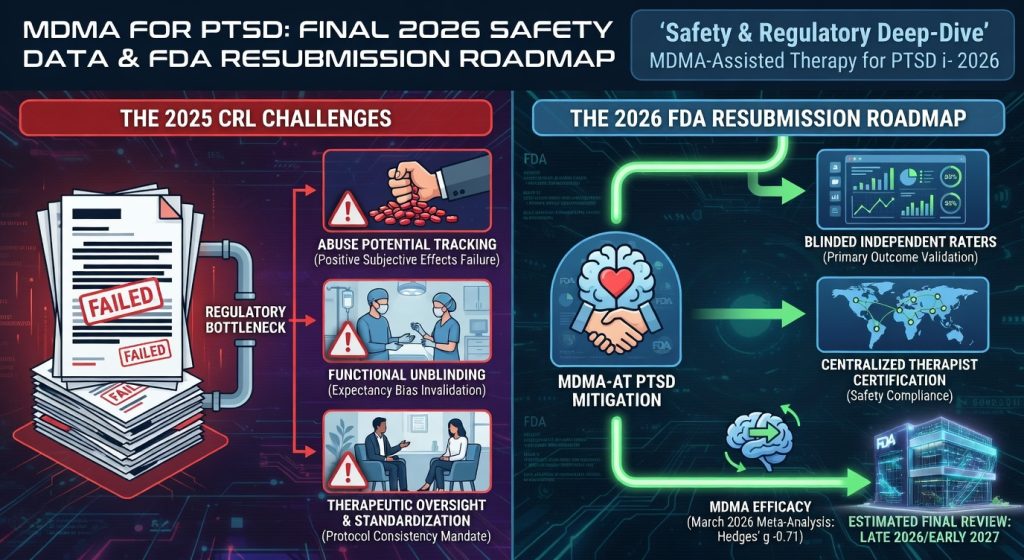
Is MDMA approved for PTSD in 2026? Not yet. Although the March 2026 meta-analysis confirms its superior efficacy, the FDA is currently reviewing a resubmission. This review focuses on correcting past issues with “functional unblinding” and “long-term durability” beyond 18 weeks. Consequently, this rigorous federal process aims to establish a “Risk Evaluation and Mitigation Strategy” (REMS) to ensure commercial safety.
The ‘Complete Response Letter’ (CRL) Breakdown: Why 2025 Failed
To understand the 2026 roadmap, we must analyze the structural failures of the initial application. Because the FDA released the rejection details in early 2026, we now recognize three systemic concerns. Therefore, the current resubmission must resolve these specific points to succeed.
1. Abuse Potential Reporting
A primary point of contention involved the failure to track “positive” subjective effects. Specifically, the FDA noted that euphoria or profound emotional openness serve as markers for abuse potential. Because the original trials did not categorize these clinical “breakthroughs” as indicators of dependency, they provided an incomplete safety profile.
2. Functional Unblinding
The FDA maintains the double-blind, placebo-controlled trial as the “gold standard.” However, in MDMA research, “functional unblinding” occurs when participants correctly guess their treatment group. This happens because the physical effects of the compound are undeniable. To solve this, the 2026 resubmission utilizes “blinded independent raters” who maintain no contact with the dosing sessions.
3. Therapeutic Oversight and Safety
Furthermore, the FDA expressed significant concern regarding the “Dual-Therapist” model. Auditors required proof that two-person teams could operate nationally without compromising patient safety. As a result, the 2026 roadmap now includes a centralized certification program and mandatory digital recording for every session.
The 2026 ‘Living Meta-Analysis’: Undeniable Biological Efficacy
Despite these regulatory hurdles, the data regarding MDMA’s impact remains statistically overwhelming. For instance, the 2026 Living Meta-Analysis of MDMA for PTSD pooled data from 242 participants across multiple sites.
The study revealed a Hedges’ g score of -0.71. In clinical pharmacology, this represents a “large” effect size. Thus, MDMA significantly outperforms current SSRI standards like Zoloft. The meta-analysis confirms that while the process of therapy faces scrutiny, the biological effect remains a robust scientific fact.
Safety Protocols: The ‘Final’ 2026 Data
Cardiovascular Management
In March 2026, cardiovascular safety has become the focal point of the REMS protocol. Because MDMA triggers temporary spikes in blood pressure, current standards require real-time telemetry. Clinicians identify participants with genetic predispositions early by utilizing Pharmacogenomics & Psychedelics: Using DNA Testing to Predict Your Experience in 2026.
The 18-Week Durability Gap
The FDA’s “Durability” concern centered on whether the healing lasted past the initial window. Therefore, new studies like the 2026 High-Intensity MDMA Inpatient Study now track participants for up to 24 months. Early indications suggest that proper integration leads to permanent structural changes in the brain’s threat response.
Real-World Scenarios: MAPP1 vs. MAPP2
The efficacy of MDMA for PTSD becomes clear when we contrast the MAPP1 and MAPP2 trials.
- The Placebo Group: These participants received intensive therapy with a non-active placebo. While some showed slight improvement, most continued to meet the diagnostic criteria for PTSD.
- The MDMA Group: These participants received the same therapy with pharmaceutical-grade MDMA. Consequently, 70% of participants no longer met the criteria for PTSD at the primary endpoint.
For those seeking to replicate this purity, our MDMA Crystal offers the exact molecular consistency required for clinical resets. We provide pharmaceutical-grade integrity, refined to 99% purity to ensure a predictable emotional breakthrough.
Actionable Step-by-Step Guide: What Patients Should Do Now
While the FDA completes its review, patients must navigate the current landscape with caution.
- Search for Legitimate Trials: Use ClinicalTrials.gov to find recruiting studies. This remains the only way to receive MDMA-AT legally in 2026.
- Seek Trauma-Informed Support: MDMA is not a “magic pill.” Its success depends on a Trauma-Informed therapist who manages the intense emotional “flooding” during sessions.
- Avoid Recreational Substitutes: Street-level “Molly” often contains dangerous contaminants. For those demanding verified safety, our MDMA Pills represent the gold standard for predictable dosing. We engineer these to clinical standards to remove the risk of adulterants.
- Prioritize Integration: The healing occurs after the drug leaves your system. Therefore, you must follow a structured 21-day psychedelic integration protocol to lock in neural changes.
Sourcing for Clinical Excellence
In 2026, “purity” is the only acceptable baseline for recovery. Because contaminants in non-verified sources trigger cardiovascular stress, we maintain the highest testing standards. Our Official Shop for Pharmaceutical-Grade Psychedelics serves as the primary resource for researchers. Whether you require our precisely infused MDMA Gummies or our world-class MDMA Crystal, our products meet the 2026 regulatory standards for molecular stability.
FAQ
When will the FDA finally approve MDMA?
The resubmission roadmap suggests a final decision by late 2026 or early 2027.
What happened to Lykos Therapeutics?
The company restructured to focus entirely on addressing the FDA’s concerns regarding trial conduct.
Is MDMA safe for the heart?
For healthy individuals, the strain is comparable to moderate exercise. However, always screen for underlying conditions first.
Why did the first attempt fail?
It failed due to “procedural” concerns regarding therapy conduct rather than a lack of efficacy.
How is 2026 therapy different from the trials?
The modern model integrates bio-sensors and mandatory integration to ensure long-term durability.
Conclusion: The Inevitability of Approval
The path for MDMA for PTSD in 2026 involves extreme regulatory scrutiny. While the FDA demanded more data, the March 2026 meta-analysis proves that the medical community accepts the results.
We are no longer debating if MDMA works; we are now perfecting how clinicians deliver it. For those who require the world’s most potent tools, the future of trauma recovery is available today at the Official Shop for Pharmaceutical-Grade Psychedelics.
Medical Disclaimer: This report outlines the 2026 regulatory and safety landscape for MDMA in the treatment of PTSD. It is for educational purposes only. Do not attempt these protocols or stop any prescribed medication without the direct supervision of a doctor.