
When researching psychedelics and problem solving, cognitive scientists increasingly focus on how psychoactive compounds alter human creative thinking. For decades, anecdotal accounts from artists, software engineers, and theoretical scientists suggested that altered states could break persistent mental ruts. Today, modern neuroimaging validates these claims, showing that compounds like psilocybin, LSD, and mescaline temporarily restructure how brain networks communicate.
Indeed, standard analytical thinking often relies on rigid, habitual logic paths. Although linear reasoning is essential for routine execution, it frequently limits true innovation when solving complex, open-ended challenges.
Therefore, this comprehensive guide explores the neuroscience of altered state thinking, how different psychedelic compounds enhance lateral association, and how structured integration turns creative breakthroughs into real-world solutions.
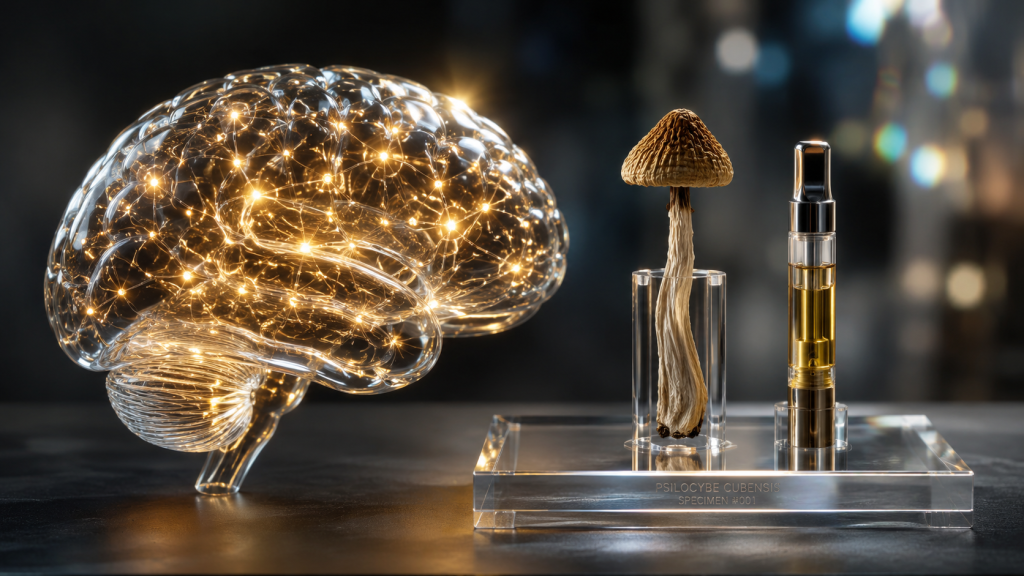
1. The Neuroscience of Creative Cognition
To understand how altered state thinking unlocks novel problem-solving, we must first look at how the human brain processes everyday thoughts.
The Default Mode Network as a Cognitive Filter
The brain relies heavily on a centralized control network known as the Default Mode Network (DMN). The DMN acts as an executive routing manager. It filters incoming sensory data based on past experiences, social conditioning, and established memory pathways.
While this filtration system saves precious mental energy, it creates cognitive rigidity. Consequently, when faced with a difficult creative or technical challenge, the brain defaults to familiar shortcuts. This mental habit prevents you from recognizing non-obvious connections.
Decreased Modular Isolation
Under the influence of serotonergic compounds, activity within the Default Mode Network decreases significantly. As a result, normal brain modularity temporarily breaks down.
Instead of operating in isolated compartments, distant regions of the brain begin communicating directly with one another. Neuroscientists refer to this hyper-connected state as increased neural entropy. This temporary biological reorganization allows the mind to form novel, highly creative associations that linear thinking misses.
To explore how these neural shifts support long-term cognitive flexibility, read Psychedelics and Neuroplasticity.
2. Associative Thinking vs. Linear Problem-Solving
Creativity is not a single mental step. Rather, it requires a delicate balance between divergent and convergent thinking.
Divergent Thinking: Expanding the Idea Space
Divergent thinking is the ability to generate many distinct, original solutions to an open-ended problem. Psychedelics excel at expanding divergent capacity. By softening rigid mental boundaries, the mind freely combines distant concepts that usually stay separate.
For example, microdosing subtle amounts using Magic Mushroom Capsules or a Psilocybin Mushroom Chocolate Bar allows individuals to access flexible, divergent states without losing functional focus during the workday.
Convergent Thinking: Refining and Testing Concepts
Conversely, convergent thinking is the analytical process of selecting, testing, and refining the single best solution. While acute psychedelic states excel at divergent idea generation, convergent refinement usually happens after the experience during the integration phase.
To learn how to structure this post-journey window effectively, review The 21-Day Critical Period: A Science-Backed Timeline for Permanent Neuro-Rewiring.
3. Historic and Modern Clinical Evidence
The relationship between psychedelics and problem solving is backed by a rich history of academic research and modern neuroimaging trials.
The 1966 San Francisco State University Study
In 1966, researcher James Fadiman and his team conducted a landmark study examining psychedelic-assisted problem solving in technical professionals. Participants included architects, electronic engineers, and theoretical mathematicians who had been stuck on specific professional challenges for months.
After receiving a controlled dose of mescaline, the participants generated groundbreaking technical solutions. These included concrete architectural designs, circuit innovations, and mathematical proofs that were later patented or published.
Modern Neuroimaging and Brain Entropy
Contemporary studies conducted at Imperial College London and archived by the National Institutes of Health (NIH) confirm these historical findings. Researchers found that psychedelics increase entropy in brain activity, allowing thought patterns to become noticeably more flexible and less predictable.
These insights align with ongoing clinical research at the Johns Hopkins Center for Psychedelic and Consciousness Research, which highlights how cognitive flexibility helps individuals overcome deep psychological and creative blocks.
4. Comparing Psychedelic Families for Creative Enhancement
Different chemical families interact with unique brain receptors, offering distinct cognitive advantages for problem-solving.
1. The Tryptamines (Psilocybin & DMT)
Tryptamines act primarily on serotonin 5-HT2A receptors, fostering deep symbolic, emotional, and spatial insights.
For mild, sustained creative exploration, many users select natural strains like Golden Teacher Mushroom, Psilocybe Mexicana Mushroom, or Psilocybe Semilanceata Mushroom. For higher-dose divergent breakthroughs, experienced researchers explore potent varieties like Penis Envy Mushroom or Psilocybe Azurescens Mushroom.
Alternatively, rapid-acting tryptamines offer brief, high-intensity visual resets. Formulations like a DMT Vape Pen, DMT Vape Cartridge, or pure DMT Crystal provide short, ten-minute shifts in spatial perspective. For non-visual, abstract conceptual shifts, others study 5-MeO-DMT using a 5-MeO-DMT Vape or 5-MeO-DMT Vape Cartridge.
For precise daily microdosing protocols, standardized formats like Psilocybin Mushroom Capsules or Psychedelic Mushroom Capsules deliver consistent dosing.
2. Lysergamides & Phenethylamines (LSD, Mescaline, 2C-B, MDMA)
Lysergamides and phenethylamines tend to provide incredible mental clarity, physical stamina, and long-lasting analytical fluidity.
Classic lysergamides like Liquid LSD, LSD Gel Tabs, or LSD Blotters are widely used in technical fields due to their sharp, clear, and highly structured visual logic. To compare lysergamides with tryptamines, review what are the big 3 psychedelics and Comparing Classic Psychedelics.
Similarly, classic phenethylamines offer profound visionary openness. Plant-derived formulations like a Mescaline Capsule or pure Mescaline HCl foster sustained emotional and conceptual clarity. Synthetic variations like 2C-B Pills or 2C-B Powder provide manageable, highly controllable aesthetic flexibility.
When creative blocks stem from emotional burnout or anxiety, empathogens such as MDMA Crystal, MDMA Pills, or MDMA Gummies facilitate deep self-compassion and team collaboration.
3. Dissociatives & Entheogens (Ketamine & Iboga)
Dissociatives offer a completely different cognitive route by temporarily detaching consciousness from standard sensory inputs.
Substances like Ketamine Powder, Ketamine Troches, and Ketamine Hydrochloride Solution block NMDA receptors. This creates an “out-of-the-box” vantage point, allowing individuals to view complex technical problems without emotional attachment or fear of failure.
For long-term psychological resets and deep ancestral reflection, natural entheogens like Iboga Root Bark offer an intense, multi-hour journey into memory and habit disruption.
5. Protocol: Harnessing Psychedelics for Problem-Solving
To successfully translate altered state insights into real-world solutions, you must follow a structured, intentional framework.
Phase 1: Clear Problem Definition (Pre-Journey)
Before entering an altered state, define your specific question or creative challenge clearly. Write down the background context, constraints, and past failed attempts. This step sets a clear direction for your subconscious mind.
Before initiating any journey, always consult The Pre-Journey Protocol: The Complete Guide to Safe, Intentional Psychedelic Preparation and review What to Expect During Your First Trip.
Phase 2: Open Exploration (During the Journey)
During the experience, release the compulsion to force an immediate answer. Instead, allow thoughts, visual symbols, and unexpected associations to flow freely without premature judgment.
If unexpected emotional intensity or mental friction arises, refer to clinical harm-reduction guidelines outlined by the Multidisciplinary Association for Psychedelic Studies (MAPS). You can also explore our core safety guides: What Is a Psychedelic Bad Trip and The Definitive Guide to Psychedelic Harm Reduction: Science, Safety, and Long-Term Integration.
Phase 3: Analytical Capture and Action (Post-Journey)
Within twenty-four to forty-eight hours after the session, record all insights, diagrams, and associations. Next, apply convergent analytical thinking to test these ideas against real-world parameters.
To ensure your body and mind maintain balance throughout this process, review Are Psychedelics Safe for Everyone? and respect the recommended rest intervals detailed in Optimal Time Between Psychedelic Trips.
Frequently Asked Questions
How do psychedelics increase creative association?
Psychedelics temporarily quiet the Default Mode Network. This reduces automatic cognitive filtering and allows distant brain regions to communicate directly, producing novel conceptual connections.
Is microdosing better for problem-solving than a full dose?
It depends on your goal. Microdosing with Magic Mushroom Capsules is ideal for everyday, functional problem-solving because it enhances focus and subtle lateral thinking without disrupting daily routines. Full doses are better suited for breaking through major conceptual blocks during dedicated reflection sessions.
Can psychedelics help with technical or scientific problems?
Yes. Historical studies and modern trials demonstrate that altered states aid in technical problem-solving by helping individuals view complex structural systems from non-linear, multi-dimensional perspectives.
Which compound is best for creative work?
Choice depends on your preference. Psilocybin strains like Golden Teacher Mushroom offer deep symbolic intuition, whereas lysergamides like LSD Gel Tabs offer sharp analytical stamina, and dissociatives like Ketamine Troches provide detached perspective.
Conclusion: Bridging the Gap Between Insight and Execution
Ultimately, exploring psychedelics and problem solving highlights the incredible adaptability of the human mind. By temporarily lowering rigid cognitive filters, altered states provide a rare window into unstructured, highly associative creative thinking.
However, a creative realization is only as valuable as the integration that follows. Combining intentional preparation, open exploration, and grounded analysis allows you to turn visionary breakthroughs into lasting real-world progress.
Ready to explore standardized formulations and educational resources for your creative journeys? Visit PsychedelicSphere today to discover our complete collection of Magic Mushroom Capsules, Psilocybin Mushroom Chocolate Bar, DMT Vape Pen, LSD Gel Tabs, and comprehensive harm-reduction frameworks designed to support your growth safely and effectively.