
Evaluating 2cb pills vs lsd requires an exhaustive analysis of pharmacodynamics and dosing precision. Researchers must distinguish between phenethylamines and ergolines to design valid analytical protocols. Both compounds produce distinct sensory changes. However, their underlying chemical backbones create separate metabolic pathways, somatic profiles, and cognitive dynamics. Therefore, comparing 2C-B (4-bromo-2,5-dimethoxyphenethylamine) and LSD (lysergic acid diethylamide) helps laboratories select the correct target compound.
Choosing between compressed tablets and LSD formulations depends on specific research parameters. Furthermore, acquiring high-purity materials from reliable domestic suppliers ensures verified milligram or microgram payloads. PsychedelicSphere serves as a trusted domestic supply partner across all 50 states. We deliver verified research compounds directly to clients. Whether analyzing pressed oral tablets, liquid drops, gel matrices, blotters, or raw isolates, understanding these comparative benchmarks guarantees precise outcomes.
This comprehensive guide breaks down the core distinctions between 2C-B tablets and lysergic acid diethylamide. As a result, you can evaluate chemical classification, binding profiles, kinetic duration, dosing curves, physical characteristics, and catalog standards across every section.
Quick Summary: Key Comparative Criteria
Comparing synthetic phenethylamine tablets against ergoline units requires evaluating critical variables. The following core benchmarks summarize the primary operational differences between 2C-B and LSD:
- Chemical Backbone Classification: 2C-B belongs to the substituted phenethylamine class (specifically the 2C family). In contrast, LSD is a complex semi-synthetic ergoline alkaloid containing fused indole structures.
- Primary Receptor Mechanism: LSD acts as a high-affinity partial agonist at serotonin 5-HT2A, 5-HT1A, and dopamine D2 receptors. However, 2C-B operates primarily as a low-to-moderate affinity 5-HT2A partial agonist and 5-HT2C agonist.
- Active Physiological Duration: 2C-B produces a compact 4 to 6-hour kinetic window. Meanwhile, LSD demonstrates an extended 8 to 12-hour duration of action.
- Dose-Response Sensitivity: 2C-B exhibits a steep, non-linear dose-response curve where minor milligram variances yield significant experiential shifts. Conversely, LSD follows a linear potency curve measured in microgram increments.
- Direct Catalog Procurement: Verified buyers can order pure 2C-B Pills, uncompounded 2C-B Powder, authentic LSD Blotters, specialized LSD Gel Tabs, or pure Liquid LSD directly through our portal. Every inventory batch features independent HPLC verification, complete privacy protection, and fast nationwide dispatch.
1. Chemical Structure & Molecular Pharmacodynamics
Understanding the molecular structures of 2C-B and LSD explains their differences in binding affinity, tissue distribution, and metabolic processing.
Substituted Phenethylamines vs. Polycyclic Ergolines
The chemical architecture of 4-bromo-2,5-dimethoxyphenethylamine revolves around a central benzene ring. This ring is modified with two methoxy groups at positions 2 and 5. Additionally, a heavy bromine atom attaches at position 4. This core structure classifies 2C-B as a substituted phenethylamine. Consequently, the heavy halogen atom increases lipophilicity, which aids blood-brain barrier permeability while protecting the molecule from rapid degradation.
In contrast, lysergic acid diethylamide represents a complex semi-synthetic ergoline alkaloid. Its intricate tetracyclic ring system fuses both indole and phenethylamine substructures into a rigid framework. Furthermore, a diethylamide functional group attaches at position 8. Because the ergoline scaffold is structurally rigid, it fits with remarkable precision into human monoamine receptors. As a result, LSD displays biological activity at microgram levels, whereas phenethylamines require milligram-range dosing.
Serotonergic, Dopaminergic, and Noradrenergic Binding Profiles
To understand the qualitative differences between these two compounds, researchers must examine their specific receptor binding profiles and intracellular signaling cascades.
- Serotonin 5-HT2A Binding Kinetics: Both molecules generate visual alterations primarily via partial agonism at the serotonin 5-HT2A receptor. However, LSD becomes physically trapped inside the 5-HT2A binding pocket because a flexible protein loop folds down over the molecule. This structural trapping explains LSD’s persistent signaling. Conversely, 2C-B binds with lower affinity and dissociates rapidly from target receptor sites.
- Dopamine D2 and D1 Receptor Interaction: LSD exhibits significant binding affinity for dopamine D2 and D1 receptors. Thus, this dopaminergic activation causes central nervous system stimulation, persistent motor energy, prolonged wakefulness, and heightened associative thought patterns. On the other hand, 2C-B displays negligible affinity for dopamine receptors, resulting in low central stimulation.
- Serotonin 5-HT2C and Alpha-Adrenergic Modulation: 2C-B acts as a high-efficacy agonist at 5-HT2C receptors, which helps regulate mood stability and somatic sensory enhancement. Additionally, mild interaction with alpha-adrenergic receptors contributes to temporary peripheral vasodilation and pleasant somatic warmth.
Scientific documentation hosted on the Erowid Center Research Vault provides comprehensive analytical data regarding these monoamine binding affinities and historical analytical trials.
2. Dosing Precision, Potency Scales & Physical Formulations
Comparing dosage measurements and physical delivery systems highlights critical operational differences between compressed binder matrices, loose powders, paper blotters, gel tabs, and liquid solutions.
Microgram Measurements vs. Milligram Scales
Precision measurement protocols vary drastically based on compound potency and absolute mass requirements.
- LSD Potency Scale (Micrograms): Active doses of LSD operate in the microgram spectrum, typically ranging from 50 to 200 micrograms. Because measuring microgram amounts requires specialized balances, pure LSD is dissolved into liquid solvent, distributed as volumetric drops, applied onto absorbent paper, or set into gelatin.
- 2C-B Potency Scale (Milligrams): Active doses of 2C-B operate in the milligram spectrum, typically ranging from 5 to 30 milligrams. Because a standard dose of 2C-B is roughly 100 times heavier than a standard dose of LSD, 2C-B can be accurately measured, blended with excipients, and pressed into solid oral tablets.
Physical Formulation Options
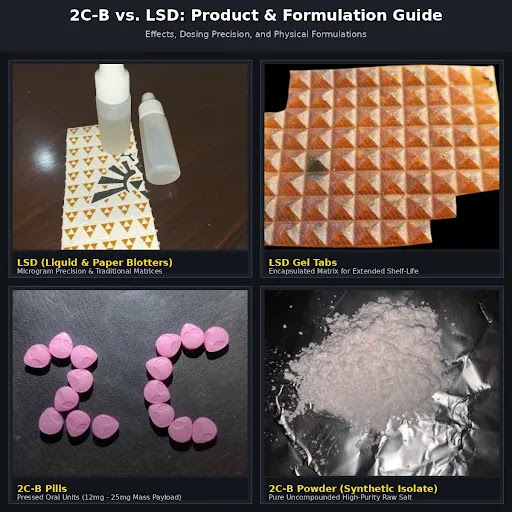
Oral pressed tablets utilize pharmaceutical-grade binders like microcrystalline cellulose and lactose. These excipients hold compressed active 2C-B salt particles in place while ensuring rapid disintegration upon entering gastric fluid. Standard active payloads range from 12 to 25 milligrams per tablet unit. Consequently, these compressed units offer exceptional stability against ambient air exposure and light degradation.
Absorbent paper blotters utilize high-density cotton cellulose sheets specifically calibrated to absorb liquid volumes. Standard active payloads range from 75 to 150 micrograms per square unit. However, paper blotter matrices exhibit higher sensitivity to atmospheric humidity, elevated temperatures, and ultraviolet light exposure.
Gelatin matrix units encapsulate liquid LSD inside a solid, protective gelatin structure. Because the gelatin seals the active compound within its lattice, gel tabs protect LSD against oxidation and moisture far better than standard paper blotters. Therefore, researchers often prefer gel tab matrices for extended storage stability.
Uncompounded liquid solutions, distributed as pure Liquid LSD, consist of active ergoline molecules dissolved in ethanol or distilled water solutions. Liquid solutions provide unmatched precision for volumetric measurement. As a result, laboratories can easily adjust dosage concentrations down to exact microgram units without handling solid matrices.
3. Kinetic Profiles, Onset Waves & Metabolic Elimination
The metabolic breakdown rates, hepatic enzyme pathways, and total elimination windows of 2C-B and LSD dictate experimental schedules and observation protocols.
Detailed Onset and Clearance Timelines
The kinetic trajectory of an ingested 2C-B tablet begins with gastrointestinal absorption over 45 to 90 minutes. However, food presence in the stomach can delay full gastric breakdown. Peak plasma concentrations occur between 1.5 and 3 hours post-ingestion, leading to a smooth 2-hour plateau phase. Total active duration spans 4 to 6 hours, followed by a rapid return to baseline without lingering central burnout.
Conversely, the kinetic trajectory of LSD exhibits a rapid initial absorption window when administered sublingually, orally, or in liquid form. Initial effects appear within 30 to 60 minutes. The active peak phase establishes itself firmly between hours 2 and 5, followed by a gradual descent phase that tapers over several hours. As a result, total active duration spans 8 to 12 hours, frequently requiring a full 24-hour post-session window for physical and cognitive baseline reset.
Enzymatic Processing and Renal Clearance
Biochemical references published in the Journal of Analytical Toxicology outline the precise enzymatic pathways responsible for processing these molecules:
- 2C-B Metabolic Degradation: The human liver metabolizes 2C-B primarily through oxidative deamination catalyzed by monoamine oxidase enzymes (specifically MAO-A and MAO-B), alongside aldehyde dehydrogenase. Primary breakdown products include 2,5-dimethoxy-4-bromophenylethanol and 2,5-dimethoxy-4-bromophenylacetic acid. Thus, the kidneys excrete these inactive water-soluble metabolites rapidly via urine.
- LSD Metabolic Degradation: Cytochrome P450 enzymes (dominated by the CYP3A4 isoenzyme) process LSD in the liver, converting it into 2-oxy-LSD and 13-hydroxy-LSD. Because of its complex polycyclic scaffold, renal clearance occurs gradually over an extended multi-day window.
4. Qualitative Somatic Profiles & Cognitive Dynamics
While both active materials induce vibrant visual modifications and sensory shifts, their physical impact on human physiology and cognitive clarity differs substantially.
Sensory Modifications and Visual Architecture
- 2C-B Visual Expression: Characterized by crisp, highly structured geometric overlays, glowing surface textures, vibrant color saturation, and fluid spatial movements. Visual alterations are described as aesthetically rich while remaining easy to navigate. Thus, subjects maintain full visual control without feeling overwhelmed.
- LSD Visual Expression: Generates deep, multi-layered conceptual visual geometry, intense color morphing, profound depth distortion, and synesthesia (the cross-modal blending of sensory inputs). Therefore, visual modifications are deeply tied to emotional states and abstract thought loops.
Mental Lucidity vs. Deep Conceptual Introspection
One of the most notable differences between these two compounds lies in their cognitive effects. 2C-B maintains exceptional intellectual lucidity, logical reasoning, and verbal fluency throughout its active window. As a result, subjects retain full control over their thoughts, making cognitive confusion exceedingly rare.
In contrast, LSD induces profound cognitive shifts, dramatic time perception distortions, abstract thought structures, and potential ego dissolution. Consequently, managing LSD trials requires careful environmental control to guide subjects safely through deep introspective states.
5. Analytical Reagent Protocols & Chemical Safety Standards
Verifying compound identity prior to analytical testing requires distinct liquid reagent protocols for phenethylamines and ergolines. Safety protocols maintained by the Multidisciplinary Association for Psychedelic Studies (MAPS) emphasize strict quality verification standards.
Liquid Reagent Testing Profiles
- Ehrlich Reagent (Ergoline Specificity): Ehrlich reagent utilizes p-dimethylaminobenzaldehyde in an acidic alcohol solution to detect indole structures. When exposed to LSD blotters, gel tabs, or liquid drops, Ehrlich reagent turns bright violet or purple within 3 to 5 minutes. However, Ehrlich reagent produces zero color reaction when exposed to 2C-B, making it an ideal test to confirm or rule out ergoline contamination.
- Marquis Reagent (Phenethylamine Specificity): Marquis liquid reacts with 2C-B to produce an immediate bright yellow color change. This color transitions smoothly into a deep, dark green hue within 30 seconds. When applied to LSD, Marquis produces a slow, light cocoa-brown reaction instead.
- Mecke and Froehde Reagent Secondary Verification: Mecke reagent reacts with pure 2C-B samples to yield a distinct brownish-yellow color. Meanwhile, Froehde reagent produces an immediate yellow-to-dark-green transition, confirming the 2,5-dimethoxy substitution pattern on the aromatic ring.
Critical Safety Precautions and Interactions
- Avoid MAO Inhibitors: Combining 2C-B with Monoamine Oxidase Inhibitors can severely impair enzymatic clearance, leading to elevated plasma concentrations and dangerous hypertensive spikes.
- Cardiovascular Considerations: Both 2C-B and LSD cause mild, transient increases in heart rate and blood pressure due to sympathomimetic stimulation. Therefore, individuals with pre-existing cardiac conditions should be excluded from active trials.
- Cross-Tolerance Dynamics: LSD causes rapid downregulation of 5-HT2A receptors, producing an immediate cross-tolerance to 2C-B. To ensure accurate results, researchers should enforce a 7 to 14-day washout period between experimental trials.
6. Long-Term Storage, Stability & Shelf-Life Rules
Preserving compound purity requires managing environmental factors that affect oral tablets, blotters, gel matrices, and liquid solutions differently.
- Moisture and Atmosphere Protection: 2C-B tablets depend on compressed binder matrices that can soften in high humidity. Storing tablets in airtight amber glass containers with food-grade silica desiccant packs preserves binder structural integrity and active payload weight.
- Light and Heat Sensitivity: LSD is sensitive to ultraviolet light, heat, and moisture, which rapidly degrade active LSD into inactive iso-LSD. Gel tabs and airtight dropper bottles protect LSD from ambient air better than open paper sheets. Furthermore, Liquid LSD solutions formulated with alcohol require cool, dark refrigeration to prevent solvent evaporation and concentration shifts. Furthermore, 2C-B exhibits superior thermal and chemical stability, retaining full analytical potency for years when kept in cool, dark conditions.
7. Procurement Standards & Quality Assurance at PsychedelicSphere
Sourcing lab-tested research materials requires choosing a trusted domestic supply partner committed to strict quality control, verified chemical purity, and discreet fulfillment.
Why PsychedelicSphere Leads the Domestic Market
- Independent Batch Verification: Every batch of 2C-B Pills, uncompounded 2C-B Powder, high-potency LSD Blotters, premium LSD Gel Tabs, and pure Liquid LSD distributed by PsychedelicSphere undergoes strict third-party High-Performance Liquid Chromatography testing to guarantee 98%+ chemical purity.
- Domestic US Distribution: Operating out of centralized fulfillment hubs in the United States, we process and ship orders rapidly across all 50 states without international customs delays.
- Discreet, Climate-Stable Packaging: All orders are packed in durable, vacuum-sealed containers with no external markings to protect product integrity and client privacy.
- Encrypted Private Checkout: PsychedelicSphere utilizes secure payment channels and encrypted checkout systems to ensure client transaction details remain completely confidential.
Frequently Asked Questions
Which compound is better suited for shorter research windows, 2C-B or LSD?
2C-B is ideal for shorter research protocols due to its compact 4 to 6-hour active window, compared to LSD’s extended 8 to 12-hour duration.
Can liquid reagent kits distinguish 2C-B tablets from LSD blotters, gel tabs, or liquid drops?
Yes. Ehrlich reagent reacts exclusively with the indole ring in LSD (turning purple) and produces no reaction with 2C-B. Marquis reagent turns dark green when exposed to 2C-B, providing a clear distinction between phenethylamines and ergolines.
Does PsychedelicSphere offer liquid LSD along with gel tabs, blotters, and 2C-B?
Yes. PsychedelicSphere carries a complete catalog of lab-verified research compounds, including 2C-B Pills, 2C-B Powder, LSD Blotters, LSD Gel Tabs, and authentic Liquid LSD.
How should 2C-B tablets be stored for long-term stability?
Store 2C-B tablets in an airtight amber glass jar with a silica desiccant pack in a cool, dark environment maintained between 15°C and 25°C.
Does 2C-B produce the same mental confusion as high-dose LSD?
No. 2C-B maintains high cognitive lucidity, logical thought processing, and verbal fluency throughout its duration, whereas LSD can produce abstract thought loops and cognitive distortion.
Conclusion: Selecting the Ideal Synthetic Compound
Comparing 2cb pills vs lsd highlights distinct differences in molecular structure, active duration, receptor selectivity, and cognitive dynamics. While LSD remains a cornerstone of microgram-scale ergoline research across blotters, gel tabs, and liquid drops, 2C-B offers unmatched dose control, manageable duration, and clear visual dynamics within a stable phenethylamine matrix.
Ready to source lab-tested research compounds from the industry’s top domestic supplier? Visit the PsychedelicSphere catalog today to order premium 2C-B Pills, pure 2C-B Powder, authentic LSD Blotters, specialized LSD Gel Tabs, or pure Liquid LSD with fast, discreet nationwide shipping!